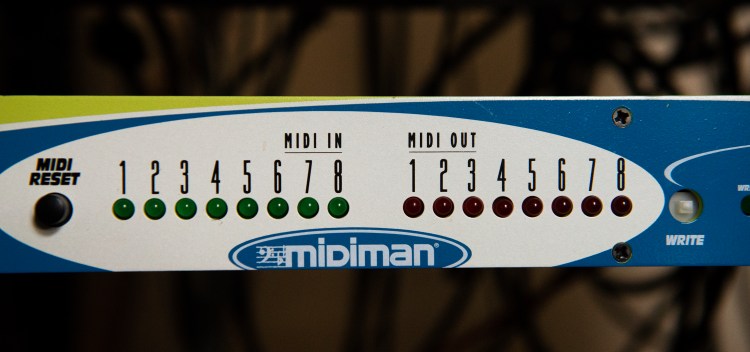
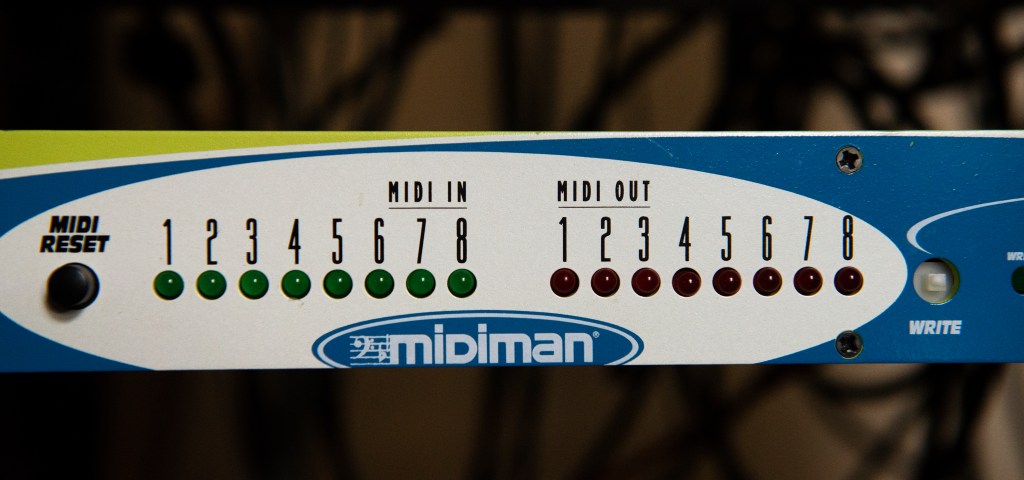
Welcome back, old friend!

More than a picture, I actually used him on this track. Him and his four string friend

It’s been a while since I posted, and that’s one of the topics of this update: things that stop us from writing songs…

I’ve always been a very prolific writer. I’d often bring three or four songs to rehearsal in a week, but I noticed something: if my lyrical partner was getting bogged down with the backlog, the tap would turn off until they started to catch up. Totally unconscious, and quite weird!

Now, as I’m not actually in a band, and I’m just writing music, what could be stopping me? I’ve mentioned a couple of times that I’m working on a project with an old friend, and while this has been in the background for around six years, often dormant for twelve months or more at a time, in the last six months we’ve actually got to the point where a couple of tracks are kind of, sort of, just visible over the horizon. These are all old tracks I wrote years ago, in fact they all predate the start of the project, but of late I’ve done a fair bit of work editing, remixing, bouncing tracks and stems to fit around my partner’s versions of the songs, and this has been messing with my head a little. Some kind of muscle memory I suppose!

Golf Whisky
So what’s this new track about? Despite the reappearance of our old friends the guitar and bass, the inspiration was some nice electric piano phrases I came up with. In the background I was playing a few different albums – “Chaos and Creation in the Backyard” by Paul McCartney, and Beck’s “Sea Change” – both records I especially love for the orchestration of David Campbell (Beck’s dad). I wanted to push my scoring envelope, so I set out to add some strings in something like his style. Of course the results don’t bear too much comparison, but I think the string arrangement is probably the best I’ve done to date.

The guitar and bass came late in the day (bass was done today in fact!), but now I’m really looking forward to more righteous shredding…

Two for the price of one

What goes in eventually comes out

I’ve been pretty productive songwriting and recording wise, but not so much as regards this blog, so I’ll catch up now and cover the last two tracks I’ve posted.

Sierra Tango
As you’ll have noticed, I’m still on a piano jag, and this is another piece that came about with me at the keyboard, and writing what are effectively fingering exercises. I liked the melancholy feel, and the lovely tone of the sampled piano.
I don’t write lyrics or sing, but I had the idea that I could do something lyrical (and almost melodic/vocal) without singing, i.e. by incorporating an “encoded” musical element. I’d heard some snatches of Morse code recently, and so decided to see if that would work. Of course I still needed source text.
I found what I was looking for while looking at the website of my favourite artist, Tom Phillips, specifically a sculpture called “After Henry James”, which contains an edited quote from James’ short story “The Middle Years”. As I don’t know Morse, I found a site that encodes text and turns it into MIDI, and, Bob’s your auntie’s live in lover…
This fitted in very nicely when I’d pitched it in the right key. Of course Morse doesn’t syncopate, which caused a few unmusical stutters, so I decided to get out my artistic licence and quantise the dits and dars, which worked wonderfully. The letters stayed coherent, but I’d need a Morse expert to say if the sense was maintained.
For the “chorus” I used the the text that Tom left out: “[o]ur doubt is our passion and our passion is our task”. Obviously I couldn’t have written better!

Mike Romeo
Similarly pianistic, but much less intellectually driven, this song came out of an idea to write a driving beat that was given texture by way of a slap back echo. That’s how it started, though, as it progressed I kept that beat and binned the texture. Such is life.
The end result is a delightful (to my mind) piece of uplifting “handbag house”. I continue to tap my toes.

Spring is in the air

Soon it will be time to break you out my pet

After taking what seemed like an age to get the last track done and dusted, my latest sprung into life very quickly: way less than twenty four hours from inspiration to posting. Spring is in the air, and I’m starting to look at breaking out the mics, preamps and guitars in earnest. (Some context here is that my current “studio” is mainly the bedroom we use as storage area for stuff we haven’t unpacked after our move back from the US, and it’s cold! COVID has temporarily put paid to our plans for a major remodel of the house, which will see me down in the basement, nice and warm and properly set up. Oh well).

Turning to the new song, “Foxtrot Mexico”… The “inspiration” came from a Sky documentary about Conny Plank, and some nice clips of Cluster and Eno. The spacey feel, and sparse keyboards, made me want to write another piano riff based song. The starting point was Eno’s “By This River” from “Before and after Science”, but I was soon diverted as I looked out of the window as I was playing, and became interested in the sunny day outside. I found a much more “up” mood: reflective still, but hopeful for the Spring.

After the electric piano riff, came a very simple arpeggiated chord that provides the slightly chime like melody. Next was the “bass” line – perhaps it’s more accurate to call it “a modulated drone that holds down the bottom end”. Finally I added the children’s choir. I’m not entirely happy with the voicing (the note lengths and velocities), but what I have is a good sketch. I can’t see this ever having vocals on it, but I’m not a singer, what do I know?

I’ll wire up my preamps, and on the next warm day, I’ll get out my acoustic guitar, and see what happens!

New Years, and new ways

Ones and zeroes organise themselves into music

After a very productive end of year, I had originally planned to do an ambient piece to clear the pipes and embark on a new phase, but that didn’t happen…

Always finish what you start, unless you don’t

An approach I’ve taken to date has been to always finish off songs: if something got recorded (even if it was just a midi sequence), I would finish it. Call it my ADD. Before and over Christmas however, and this was a first for me, I started several pieces but couldn’t really progress them. What to do?

In the end, I simply started a new piece, much more akin to what I’d been working on up to that point, and figured things out pretty quickly. “November Hotel” was another excursion into chord generators, and is essentially a black notes only composition. I was very pleased with the feel of the track – it has a hymn-like quality, and has the twin (and opposing) elements that I think of as characteristic of my writing: a combined, upbeat, melancholy!

I actually finished the writing and tracking before Christmas, but then got distracted by some editing work I needed to do on an old piece that is going on the record I’m making with my singing, lyric writing collaborator. More will follow.

Lesson: clear out as you go, and always keep moving forwards

Given my credo is “work with what music comes out”, I guess I learned that I should trust my credo! I’ve also taken the very uncharacteristic step of deleting the three of four false starts I tried out. If I couldn’t make them work, why let them take up ones and zeroes on my hard drive; I know I’ll never go back to them…

…A new song is “finished”

Kilo Alpha” proved a very easy starter for this blog: they don’t always turn out this straightforward!

As I tend to like a linear approach to writing – I start at the verse, and work forwards to a chorus, middle eight (or whatever) – I sometimes struggle after a strong beginning. I’ll often write lots of strong following sections, they just don’t follow the start. I guess that’s a nice problem to have.

In the case of this song, the verse and chorus lined up pretty much straight away. I needed only the slightest nudge to get the bits to fit together. In this case the “nudge” was a device I like: using a simple repeating phrase (6 notes – CDCEDC), with a breakdown in the drums, which I echoed at the end of the chorus (5 notes – EFGED), with the same drum breakdown.

The only deviation from my linear approach is where I decide I need an intro. If I have a middle eight I’ll sometimes start with that, with maybe some slight alteration. In the case of this song, I took elements of the chorus and changed the piano and horn parts, and added a very different organ part. I think this section worked well to build up to, then break down in the first verse.

One thing I should point out about the songs on my SoundCloud – I write pieces to be as complete as they can be in terms of melody, but because I don’t write lyrics or sing, they have a definitely unfinished quality. I think of them as largely awaiting a vocal, and so don’t worry too much about structure, as a singer/lyricist tends to say “I’ve written a shorter verse”, or “you had two verses, I wrote four, can you edit the song”. I don’t get precious about that, hence the arrangements I start out with.

My instrumental pieces are pretty much complete for the opposite reason!

A new song begins…

After finishing one song, I typically start a new one pretty much straight away. Sometimes I literally start as soon as I’ve “mastered” and posted the last one.

It’s not unusual for me to be in a particular place for a couple of songs – I might be feeling orchestral or dance-y for a few weeks – but I try to mix things up. One technique I have is to do something improvised, and somewhat automatic. I liken (though don’t compare!) this to Tom Phillips‘ “Terminal Greys” series of paintings. In his case it’s literally a palette cleanser, as well as a way of rinsing away the day’s thoughts, in mine it’s a way of clearing stuff out of my head to start something new. For identification purposes: they’re markedly different from what precedes or succeeds them!

Document 2” is one of these pieces. It’s not in my usual, poppy style, but that’s the point – it’s a break or a sidebar. The idea was to set up musical and sound loops of different length, then let them play against each other, drifting in and out of different harmonic and melodic relationships.

Another, less ambient approach I use is to set rules – for example in “Power of Two” I introduced eight, sixteen, thirty two, and sixty four bar themes throughout the song. The real gem in this song was the “found” muezzin’s call to prayer, which matched the song in terms of key and tempo.

As the idea of this blog is to talk about songs in progress, let’s turn to my newest piece “Kilo Alpha“. The starting point for this was a desire to find something interesting on a Rhodes style piano. As I was playing around in Reason, the main riff came to me, originally as a two bar motif, but after I’d recorded it, I added some changes. Next came the nice tight drum loop. I’m currently looking for a horn sample, so I’ve been trawling through the “Soul School” ReFill. The one in the current version of the song is pretty nice, but also somewhat like a horn part I added in another song, so I’ll probably change it. What I currently have is likely the first verse…

…One thing I find interesting about how different writers write, is the linear progress through a song. I remember an interview with Sting where he said he always wrote the chorus first, then worked back from there. I can see the logic of that: a chorus should be strong, and contain the hooks. I almost always write in sequence, i.e. the first thing I write is going to be the verse, then what follows will be a bridge or chorus. Because I don’t intentionally write vocal melodies or lyrics, I can’t write something fairly mundane, then shine it up with a really good tune or clever words. As a result, my verse has to be strong (as far as I’m concerned) for me to stay interested in it. Then I have to try hard for the chorus to go somewhere different and even stronger!

While we’re still at the beginnings stage with this blog, you may find my titles a little strange. When I wrote with a collaborator I used to add titles, simply because I needed something to call the file I was saving to. Sometimes, however, I’d find that some random title that might have come from a book I was reading at the time (“Nixonland” for example) would start to influence the lyricist. Then I hit on the idea of using the NATO Phonetic Alphabet, which came around the time I was most obsessed with the Conet Project. Generally the phonetic title will relate to the feel of the track, so, “November Yankee” related to the kind of dreamy New York I was trying to evoke. “Bravo” will typically relate to there being a prominent or different kind of beat that interested me.

Let’s start by talking about process…

This machine kills lack of imagination

“Process” doesn’t sound like it’s something associated with the arts. Based on Hollywood biographies, we often see artists as tortured, erratic souls, and lightning rods for bolts of divine inspiration. I’ve been in many artist’s studios (the painterly and the musical sort), and they’ve all been workplaces in the truest sense of the word – places where creative people go to create, tuned to the particular artist’s creative process.

I’m sure there are disorganised, dissolute creators out there, but the artists I’ve met, spoken to, and, on occasion worked with are Grammy award winners, Royal Academicians, and recipients of gold and platinum disks. They go seeking inspiration. They work hard, and often everyday, to unlock their creativity.

I’ve no Grammy awards, or platinum disks, and I’m not a member of the RA, but before we talk about individual songs, I’ll explain how I work.

Space
I’m lucky enough to have a dedicated space for my writing and recording, and for me, that’s important. Everything I play or use is within arm’s length of my desk chair, and the most effort I need to expend to get started, is to switch on an amplifier. I find that the worst disincentives to my working are the trivial ones, such as getting myself situated. Once I’m writing or recording, I’m happy and engrossed.

Some people find a separation between their living space and their working space is a good thing. I can see this for artists with families, or for people who need to physically distance themselves from the work to decompress. Personally, I don’t want to have to get in the car, or use public transport to get to my workspace, and it’s great to just go up or down some stairs at home.

Getting started
My approach to song writing is largely based on sound. I rarely hear tunes in my head: for me it’s usually a case of trying to find a sound or a melody that I want to develop. I very consciously go and seek those, and have a few different approaches:
Playing the guitar – the guitar is the only instrument I can actually play, everything else is a hack. I write less on a guitar these days, but when I do, I generally just sit down, pick up a guitar – doesn’t matter if it’s electric or acoustic, or if it’s plugged in – and just start to make noise. I often trance out doing this, just strumming or picking for as long as I’m enjoying it, until something stands out. This can be a cluster of notes, which could be a riff or an arpeggio, or an interesting chord voicing. From there it’s a matter of finding where the song goes, what comes next. This isn’t an easy process, but once I find something interesting I feel that I need to follow the breadcrumbs.
Different guitars obviously have different sounds, so I purposely don’t always pick up the same guitar. Equally, electric guitars played through different effects point me in different directions, so I might play with distortion, echo or reverb to get things moving.
If I’m writing on guitar, and I have something that’s working, I record it. As my recording set up in my studio is always ready to go, I can record something that’s near a “keeper”, and often that original idea stays in the song until the end, and I have some of the original freshness in the final track.
Hammering away on keyboards – All of my keyboards are electronic, and I can only use them with Digital Audio Workstations (DAWs) such as Reason, Ableton Live, Maschine, or Pro Tools. For me, that has a lot of advantages: I have access to a massive range of synthesizers, samplers and sampled instruments, and aids such as chord generators. I really can’t play keyboards, so anything that helps me cut to the chase and write is a massive plus.
Reason has some fantastic sampled pianos, Native Instruments have some amazing synthesizers, and I find the range of sounds usually triggers something. Of some recent tracks I’ve written…
Person Woman Man Camera TV, came about because I was playing with the Metaphysical Function sound generator and Rounds in Native Instruments’ Reaktor. The song pretty much jumped out at me from those instruments.
Alpha Sierra was me looking for a rich piano sound, settling on a wonderful sampled piano in Reason, and using a chord generator. I’ve no idea where the jazz feel came from, probably from the drum loop in Addictive Drums that seemed to work well with the song I found.
Finding a good drum loop – This is a hybrid of the above, in that I look for a drum loop that has some kind of energy that attracts me – it could be upbeat and dance oriented, or slow and trippy – and from there I’ll find something that works well on top, such as guitar chords or riffs, or piano or synths.
Inspiration from another song – I don’t look to rip off other songs, but sometimes I hear some motif, or “feel” in a song or piece of music, and decide I want to explore that approach. This doesn’t happen too often, but some examples I can think of are:
LPG – I’m quite a fan of The Verve, and was interested when they released their comeback single “Love is Noise”. I actually didn’t like the song very much, but I liked the sampled vocal motif (the kind of “ohoh ohoh ohoh” riff), and wanted to try something in that vein. It’d be hard to point at LPG and say “that’s a steal from ‘Love is Noise'”, but once I had the four note synth riff, the rest of the song followed.
Papa Bravo – This track had two distinct inspirations. I’d really liked the Radiohead single “Burn the Witch”, particularly the pizzicato strings that drove the song, but never really got around to writing anything along those lines. The kicker was watching the TV series “The Bureau”, where the incidental music often had pizzicato in it. I started playing with string samples, and this song came out.

The song goes where it wants
As I’m following the paths I’ve talked about, I’ll often start off in one direction, and get quite a distance, then find out that the inspiration for the song might not fit anymore. This sounds counter intuitive, but sometimes something that starts out key to the track, just doesn’t fit anymore. It took me ages to get over being too attached to parts of songs, but after a few mixes that didn’t work because of my obstinacy, I learned to be much more ruthless with my writing – if the song works better without something, regardless of what it is, can it!

The right tools
By this, I clearly mean ‘the right tools for you’, but here’s what I use…
Writing
I use all DAWs mentioned above for writing, though usually not Pro Tools for the initial creation. As ‘writing’ in my world often equates with ‘sequencing’, if I’m not starting out on guitar, I’ll use one or more MIDI sequencers to get things going, they all have their individual strengths. Based on my experience:
Reason is great for its synths and samplers, and block/song mode is brilliant for structure. There are also lots of plugins and ReFills such as “Soul School” and “Disco School”
Maschine is wonderful for raw inspiration – there are tons of great drum loops, and very rich sound sources such as Reaktor and Massive
Ableton Live is really strong for less structured working, especially if you have a control surface to trigger patterns. With Live it’s really easy to try out different layers in real time until something really jumps out
Pro Tools is more my ‘tape’, or my ‘multitrack’, where I bounce the stuff I’ve been working on elsewhere to audio tracks for editing, mix and mastering. I often use several DAWs inside Pro Tools, loading them into instrument tracks
(While it’s not strictly related to songwriting, I’ll talk about my signal chain in another post)

That came out way longer than I expected, but hopefully you’ll find it useful, or even just bizarre and entertaining. The next song I start, I’ll catalog my trials and tribulations right here!